OpenAI Strawberry (RLHF + CoT)
OpenAI o1 (codenamed Strawberry) combines reinforcement learning with internal Chain-of-Thought (CoT) reasoning so the model generates hidden reasoning tokens before emitting a final answer. Unlike traditional RLHF that optimizes single-pass response preferences, o1 uses large-scale reinforcement learning—largely driven by verifiable outcome rewards—to refine multi-step reasoning and trade extra test-time compute for higher accuracy.
Study Card: OpenAI’s Strawberry (o1) — RL + Chain of Thought
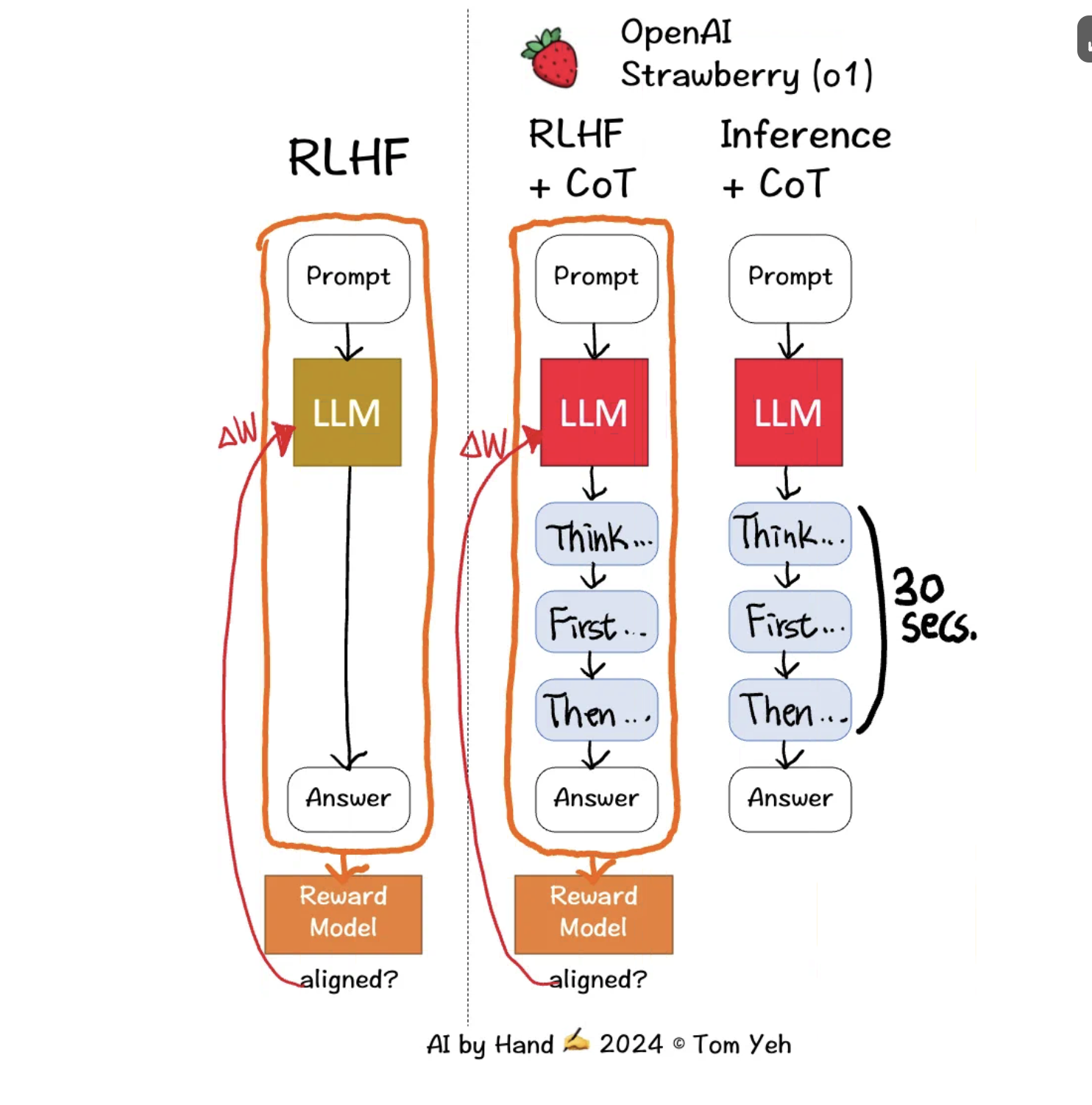
This study card explains the core concepts illustrated in Prof. Tom Yeh’s animation comparing traditional RLHF with OpenAI’s reasoning model o1 (codenamed Strawberry), highlighting how reinforcement learning integrates with internal Chain-of-Thought (CoT) reasoning.
I. Key Concepts
- Reinforcement Learning with Human Feedback (RLHF): An alignment technique where human preference comparisons train a reward model that guides the LLM to produce helpful, safe, human-preferred responses.
- Chain of Thought (CoT): Generating explicit intermediate reasoning steps before producing a final answer, improving multi-step problem solving on math, coding, and logic tasks.
- OpenAI o1 (Strawberry): A reasoning-focused LLM trained via large-scale reinforcement learning to generate an internal Chain of Thought before delivering its final response, scaling performance with both RL training compute and test-time compute.
II. Walkthrough of the Three Panels
-
Left Panel — Traditional RLHF:
- Flow:
Prompt -> LLM -> Answer -> Reward Model -> Aligned? - Standard RLHF primarily evaluates and rewards the final answer directly rather than incentivizing prolonged internal reasoning beforehand.
- Flow:
-
Middle Panel — Training Reasoning Models (RL + CoT):
- Flow:
Prompt -> LLM -> CoT Tokens (...) -> Answer -> Reward / Verification -> Update Policy - Rather than jumping straight to an answer, the model generates an extended sequence of intermediate reasoning tokens (
CoT) before emitting the final response, and reinforcement learning optimizes the entire trajectory toward producing accurate, well-aligned outcomes. - Important nuance on reward signals: While the high-level animation contrasts evaluating only the final answer vs. the full
CoT + Answertrajectory, OpenAI noted in its o1 technical post that reasoning RL primarily relies on outcome-based / verifiable rewards (e.g., whether a math proof or unit test passes, plus safety checks on the visible answer) rather than heavily constraining raw CoT tokens with human style preferences—allowing the model to freely explore, backtrack, and self-correct inside its hidden thought process.
- Flow:
-
Right Panel — Inference with Internal CoT (Test-Time Compute):
- Flow:
Prompt -> LLM -> CoT Tokens (...) -> Answer - At inference time, the model generates internal reasoning tokens autoregressively one token after another within a single decoding pass (reusing its KV cache, rather than making separate stateless API calls per thought) before outputting the final answer.
- Because each reasoning token requires a forward decoding step, harder prompts take more “thinking time” (seconds to tens of seconds of test-time compute) in exchange for substantially stronger reasoning accuracy.
- Flow: